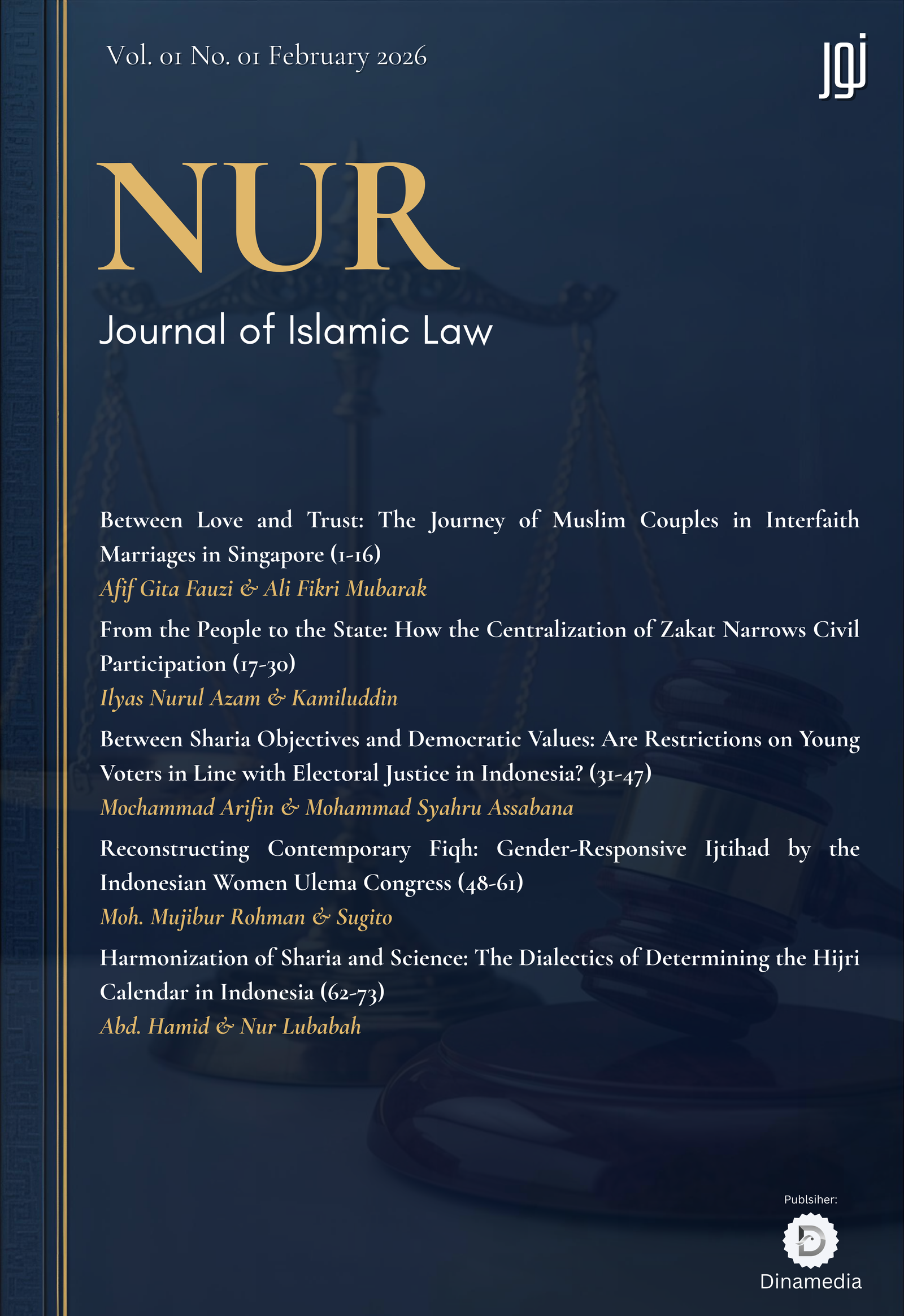
Between Love and Trust: The Journey of Muslim Couples in Interfaith Marriages in Singapore
Keywords:
Interfaith marriage, Sharia Law, Singapore, Muslim LawAbstract
Among Singapore’s Muslim population, marriages between individuals of different faiths have emerged as a growing social development. The prevalence of such unions has risen partly due to Singapore’s Women’s Charter, which provides legal authorization for matrimony between Muslim and non-Muslim partners—a practice that conflicts with Islamic religious teachings. Additionally, the Administration of Muslim Law Act 1966 (AMLA) contains no explicit restriction preventing Muslims from entering civil marriage contracts with spouses outside their faith. This study examines the underlying reasons for this upward trend and analyzes how Muslim legal frameworks in Singapore address these cross-faith unions. Using qualitative research methodology that combines documentary analysis with empirical fieldwork, the researchers employ descriptive techniques and thematic examination of interview data. The findings reveal that the primary driver behind rising interfaith marriages is the lack of Islamic legal prohibitions against such unions, coupled with limited consequences for those who enter them. In practice, implementing new Syariah regulations to ban interfaith marriages faces significant contextual obstacles within Singapore’s social and legal landscape. Consequently, the researchers advocate for a balanced, practical strategy that acknowledges Singapore’s diverse religious and ethnic composition, reconciles religious doctrine with existing legal structures, and emphasizes education and counseling for Muslim communities.
Downloads
References
Abbas, A. N. (2012). The Islamic legal system in Singapore. Pacific Rim Law & Policy Journal, 21, 163–187.
Abbas, A. N., Ibrahim, I. P., & Rozlan, M. H. (2022). Muslim family law in Singapore. Singapore: Singapore Academy of Law.
Abdelnour, M. G. (2020). The Islamic theology of interfaith marriages between theology, law, and individual ijtihad. Interreligious Relations, 17, 1–14.
Al-Bukhari, M. B. I. (1400). Sahih Al-Bukhari. Damsyiq: Dār Tauq al-Najah.
Ali, M. (2022). Fatwas on interfaith marriage in Indonesia. Studio Islamika, 9(3), 1–33. https://doi.org/10.15408/sdi.v9i3.658
Arifin, Z., Bayhaqi, N. G., & Pradhan, D. (2024). Urgency Supreme Court circular letter number 2 of 2023 in the judicial process of interfaith marriage registration. Journal of Law and Legal Reform, 5(1), 137–178. https://doi.org/10.15294/jllr.vol5i1.2101
Ash-Shafi’i, M. I. (n.d.). Al-Umm. Bayrût: Dār al-Kotob al-Ilmiyah.
Aziz, A., Nugraha, I. S., Aminudin, S., & Hakim, L. (2024). Hukum Islam Jurnal Supreme Court’s decision regarding the prohibition of interfaith marriage and its relevance of maqasid al-sharia. Jurnal Hukum Islam, 22(1), 243–278. https://doi.org/10.28918/jhi_v22i1_8
Bakar, A. A. (1979). Hukum berkahwin dengan kitabiyyah. JMCL, 6.
Basid, A., Kholidah, L. N., Hidayatullah, M. F., Firmansyah, E. K., Zunaih, A. I., & Zahid, R. A. (2024). Interfaith marriage controversies in Semarang: An analysis of Qur’anic legal exegesis. Malaysian Journal of Syariah and Law, 12(3), 762–777. https://doi.org/10.33102/mjsl.vol12no3.812
Bretault, F. (2023). Challenges of interfaith families in Singapore, and beyond. Union Catholic of Asian News. Retrieved from https://www.ucanews.com/news/challenges-of-interfaith-families-in-singapore-and-beyond/103178
Conway, A. (2023). Sacred engagements: Interfaith marriage, religious toleration, and the British novel, 1750–1820. Baltimore: Johns Hopkins University Press.
Dikuraisyin, B., Sumarkan, Fatwa, A. F., & Ghozali, M. L. (2024). Reconstruction of marriage law: Judges’ progressive reasoning based on maqāshid in addressing divergent interpretations in Indonesian courts. Al-Manahij: Jurnal Kajian Hukum Islam, 18(2), 237–254. https://doi.org/10.24090/mnh.v18i2.9436
Djamour, J. (2021). The Muslim matrimonial court in Singapore (1st ed.). London: Routledge. https://doi.org/10.4324/9781003135968
Elita, R., Layla, F., Naristya, C., Akbar, Z., & Jannah, M. (2024). Rights of children from interfaith marriages: Child registration case in Semarang, Indonesia. Contemporary Issues on Interfaith Law and Society, 3(1), 43–84. https://doi.org/10.15294/ciils.v3i1.76555
Faizi, H. F. S., Ahmad, K., Hussin, M. N. B. M., & Samah, M. (2024). Divorce and khula: A comparative study of prevailing family laws in Pakistan and Malaysia. Pakistan Journal of Life and Social Sciences, 22(1), 1105–1117. https://doi.org/10.57239/pjlss-2024-22.1.0075
Farid, D., Pakarti, M. H. A., Hendriana, & Fathiah, I. (2022). Interfaith marriage: Subjectivity of the judge in determination of No. 454/Pdt.p/2018 Surakarta District Court. Al-Istinbath: Jurnal Hukum Islam, 7(2), 347–362. https://doi.org/10.29240/jhi.v7i2.4574
Gemilang, K. M., Firmanda, H., Maghfirah, Lastfitriani, H., & Hakimi, A. R. (2023). Discussing the phenomenon of the appointment of judges in district courts regarding interfaith marriages from a legal logic perspective. Al-Istinbath: Jurnal Hukum Islam, 8(2), 307–324. https://doi.org/10.29240/jhi.v8i2.8185
Giammetti, M. (2024). Inter-religious architecture for wedding spaces. Religions, 15(8). https://doi.org/10.3390/rel15081022
Gunawan, E., Tohis, R. A., & Hakim, B. R. (2023). Implications of the law of religious moderation on interfaith marriages. Jurnal Ilmiah Al-Syir’ah, 21(2), 283–296. https://doi.org/10.30984/jis.v21i2.2649
Hamdanah, H. (2018). Psychological impacts on interfaith families in Palangkaraya in educating their children. The Open Psychology Journal, 11, 279–291. https://doi.org/10.2174/1874350101811010279
Hedi, F., Anshori, A. G., & Harun, H. (2017). Legal policy of interfaith marriage in Indonesia. Hasanuddin Law Review, 3(3), 263–276. https://doi.org/10.20956/halrev.v3i3.1297
Hussin, M. N. M., Daud, M. Z., Hanafi, H., & Samudin, S. A. (2024). The division of harta sepencarian of Muslim converts upon conversion in Malaysia. Malaysian Journal of Syariah and Law, 12(2), 282–295. https://doi.org/10.33102/mjsl.vol12no2.578
Hussin, M. N. M., Daud, M. Z., Noor, R. M., & Omar, A. C. (2023). Kajian isu-isu berkaitan pemeliharaan akidah dan pemikiran umat Islam di Malaysia: An analysis of issues relating to aqidah and beliefs among Muslims in Malaysia. Malaysian Journal of Syariah and Law, 11(2), 366–380. https://doi.org/10.33102/mjsl.vol11no2.454
Ibrahim, I. A. (2021). The Muslims in Malaysia and Singapore: The law of matrimonial property. In Family law in Asia and Africa (pp. 182–204). London: Routledge. https://doi.org/10.4324/9781003243397-11
Indrayanti, K. W., Saraswati, A. A. A. N., & Putra, E. N. (2019). Questioning human rights, looking for justice: Analyzing the impact of Supreme Court circular letter on interfaith marriages in Indonesia. Sustainability, 11(1), 1–14. https://doi.org/10.15294/jils.vol9i1.4634
Islam, M. Z. (2014). Interfaith marriage in Islam and present situation. Global Journal of Politics and Law Research, 2(1), 36–47.
Jones, G. W. (2021). Divorce in Malaysia: Historical trends and contemporary issues. Institutions and Economies, 13(4), 35–60. https://doi.org/10.22452/IJIE.vol13no4.2
Jones, G. W., Leng, C. H., & Mohamad, M. (2009). Muslim-non-Muslim marriage: Political and cultural contestations in Southeast Asia. Singapore: Institute of Southeast Asian Studies. https://doi.org/10.1355/9789812308221
Kamarusdiana, K., Yusuf, B., Hakim, M. R., & Dahri, H. (2022). Pre-marital education: Concepts and regulations in Indonesia and Malaysia. Al-Ahkam, 32(1), 41–64. https://doi.org/10.21580/ahkam.2022.32.1.10709
Kuan, E., Seah, E. Q., & Sing, T. F. (2022). Preparing for rainy days in old age in Singapore: Singapore’s Central Provident Fund (CPF) system and lease buy scheme (LBS). In International comparison of pension systems: An investigation from consumers’ viewpoint (pp. 269–290). https://doi.org/10.1007/978-981-19-6446-6_8
Kum, L. W. (2018). Elements of family law in Singapore (1st ed.). Singapore: LexisNexis.
Laluddin, H., Manap, N. A., Shariff, A. A. M., Husni, A. M., Kusrin, Z. M., Ibrahim, I. A., & Manap, N. A. (2014). The contract of marriage and its purposes from Islamic perspective. Asian Social Science, 10(2), 139–144. https://doi.org/10.5539/ass.v10n2p139
Law, S. (2020). Muslim inheritance law – Faraid. I.R.B. Law LLP. Retrieved from https://irblaw.com.sg/learning-centre/muslim-inheritance-law-faraid/
Maloko, M. T., Chotban, S., Fuady, M. I. N., & Hasdiwanti. (2024). Analyzing the prohibition of interfaith marriage in Indonesia: Legal, religious, and human rights perspectives. Cogent Social Sciences, 10(1), 2308174. https://doi.org/10.1080/23311886.2024.2308174
Mangarengi, A. A., & Hamzah, Y. A. (2021). The position of the marriage law on interfaith marriages abroad. SIGn Jurnal Hukum, 3(1), 65–83. https://doi.org/10.37276/sjh.v3i1.127
Maula, B. S., & Muhsin, I. (2024). Interfaith marriage and the religion–state relationship: Debates between human rights basis and religious precepts. Samarah, 8(2), 791–820. https://doi.org/10.22373/sjhk.v8i2.19479
Mohamad, H. (2019). Overview of Syariah law in family matters. In V. Thean & F. S. Fong (Eds.), Law and practice of family law in Singapore (p. 649). Singapore: Sweet & Maxwell Asia.
Muchimah, Jahar, A. S., Hamdani, & Fajarini, U. (2024). Legal culture and the dynamics of religious interaction in ritual practices among interfaith marriage. Al-Manahij: Jurnal Kajian Hukum Islam, 18(2), 333–348. https://doi.org/10.24090/mnh.v18i2.11659
Munir, A. A., Sahid, M. M., Zulkifli, & Fauzi, A. (2021). The reasons for permission to marry ahlul kitāb women in the view of Sayyid Sabiq. Al-’Adalah, 18(2), 289–302. https://doi.org/10.24042/adalah.v18i2.10350
Mutalib, H. (2006). Singapore Muslims: The quest for identity in a modern city-state. Journal of Muslim Minority Affairs, 25(1), 53–72. https://doi.org/10.1080/13602000500114116
Nasir, M. (2022). Negotiating Muslim interfaith marriage in Indonesia: Integration and conflict in Islamic law. Mazahib, 21(2). https://doi.org/10.21093/mj.v21i2.5436
Nasir, N. M., Mustafa, I., Aris, M. M. M., Azmn, F., & Razali, N. A. (2024). Fatwas of Singapore volume 2: Inheritance and estate planning. Singapore: Majlis Ugama Islam Singapura.
Ng, B. C., Tan, M. J. J., Pauwels, A., & Cavallaro, F. (2024). Language practices in Malay-Chinese families in Singapore. Journal of Multilingual and Multicultural Development, 45(8), 2940–2960. https://doi.org/10.1080/01434632.2022.2080214
Noor, N. M., & Leong, C.-H. (2013). Multiculturalism in Malaysia and Singapore: Contesting models. International Journal of Intercultural Relations, 37(6), 714–726. https://doi.org/10.1016/j.ijintrel.2013.09.009
Pasuni, A. (2018). Negotiating statist Islam: Fatwa and state policy in Singapore. Journal of Current Southeast Asian Affairs, 37(1), 57–88. https://doi.org/10.1177/186810341803700103
Peshkova, V. M. (2024). Mixed marriages: Factors, characteristics and impact on family and society (review of foreign studies). Sociological Journal. https://doi.org/10.19181/socjour.2024.30.3.6
Rahman, N. A. A. (2016). Singapore’s Muslim law versus Syariah revivalism. ISEAS, 36, 1–9.
Rahmawati, E. S., Zuhriah, E., Zaman, J. Q., Mafaz, F. A., & Samudin, S. A. (2024). Using case broker instead of mediator in tribunal process: Case study in marriage law. PETITA, 9, 742. https://doi.org/10.22373/petita.v9i2.320
Rajafi, A., Sugitanata, A., & Lusiana, V. (2024). The ‘double-faced’ legal expression: Dynamics and legal loopholes in interfaith marriages in Indonesia. Journal of Islamic Law, 5(1). https://doi.org/10.24260/jil.v5i1.2153
Rifayanti, R., Ramadhani, A., Rahman, N. N., Zahra, N., Affifa, K., & Adilah, S. (2024). A theological study of the impact of an interreligious marriage: Self-adjustment in couples from different religions. Pharos Journal of Theology, 105(2). https://doi.org/10.46222/pharosjot.105.228
Rosdiana, R., Saumin, U. H. Y., & Maisarah, M. M. (2019). Legitimacy on inter-faith marriages: An analysis of the role of religious councils on the legal policy in Indonesia. Ahkam: Jurnal Ilmu Syariah, 19(1). https://doi.org/10.15408/ajis.v19i1.11710
Rosidah, Z. N., Karjoko, L., & Palil, M. R. (2023). The government’s role in interfaith marriage rights protection: A case study of adjustment and social integration. Journal of Human Rights, Culture and Legal System, 3(2), 265–287. https://doi.org/10.53955/jhcls.v3i2.105
Sallam, A. S. M., Harun, M. S., & Samudin, S. A. (2024). Reassessing women’s humanity: A comparative study of Islamic teaching and societal perceptions. Afkar: Jurnal Akidah dan Pemikiran Islam, 26(2), 337–374.
Samah, M., Abdullah, R., Hussin, M. N. M., & Ferdousi, N. (2023). Dato’ Yutitam in the civil court system of Thailand. AHKAM, 23(1), 121–146.
Sarifudin, S. (2019). Kawin beda agama dalam kajian hukum Islam dan peraturan perundang-undangan di Indonesia. Al-Istinbath: Jurnal Hukum Islam, 4(2), 213–230. https://doi.org/10.29240/jhi.v4i2.787
Setiawan, I., Arifin, T., Saepullah, U., & Safei, A. (2024). Reforming marriage law in Indonesia: A critical examination of Islamic law on the ban of interfaith marriages. Al-Manahij: Jurnal Kajian Hukum Islam, 18(2), 179–198. https://doi.org/10.24090/mnh.v18i2.11134
Setiyanto, D. A., Aryani, S. A., & Wahyuni, S. (2024). ICRP Jakarta and interfaith marriage assistance in Indonesia: Civil rights, legal interpretation, and advocacy for interfaith couples. Journal of Islamic Law, 5, 170. https://doi.org/10.24260/jil.v5i2.2796
Shesa, L., Dzar, M. A., & Utami, H. S. (2024). Reformulating progressive fiqh of talak (divorce): A contemporary study of the principle of making divorce more difficult in SEMA No. 1 of 2022 for women’s protection. MILRev: Metro Islamic Law Review, 3(2), 236–262.
Steiner, K. (2018). Branding Islam: Islam, law, and bureaucracies in Southeast Asia. Journal of Current Southeast Asian Affairs, 37(1), 27–56. https://doi.org/10.1177/186810341803700102
Suratman, S. (2021). Skills for ‘marriage of a lifetime’: An examination of Muslim marriage preparation handbooks in Singapore, 1974 to 2018. Religions, 12(7), 473. https://doi.org/10.3390/rel12070473
Suyaman, P., & Alfiany, T. F. (2022). Polemics of interfaith marriage reviewed from the perspectives of marriage law and the compilations of Islamic law. KnE Social Sciences, 537–549. https://doi.org/10.18502/kss.v7i15.12129
Tezcan, T. (2024). Gender gap in religiosity and interfaith marriage attitudes: Muslim migrants in Germany. International Journal of Intercultural Relations, 102, 102040. https://doi.org/10.1016/j.ijintrel.2024.102040
Thahir, A. H. (2024). Towards the multidimensional ushul al-fiqh: A study of the integration of science in the fatwa of Majelis Ulama Indonesia. Samarah: Jurnal Hukum Keluarga dan Hukum Islam, 8(2), 687–705. https://doi.org/10.22373/sjhk.v8i2.19686
Tuan Khairul Hafiz bin Anuar, Sharie Counsel. (2024, April 30). Personal interview.
Umriana, A. (2024). Exploring interfaith marriage in Qur’ān: A hermeneutic and anthropological analysis of permissibility. Journal of Islamic Thought and Civilization, 14(2), 370–385. https://doi.org/10.32350/jitc.142.22
Widyawati, F. (2024). University student’s perceptions on interfaith marriage in Indonesia: Openness, idealism, and reality. Religions, 15(6), 745. https://doi.org/10.3390/rel15060745
Yeung, W.-J. J., & Jones, G. W. (2024). Emerging dimensions of marriage in Asia. Journal of Family Issues, 45(5), NP1–8. https://doi.org/10.1177/0192513X231157403
Zin, N. M., Jani, H. M., Hamid, A. G., & Hak, N. A. (2019). Jurisdictional conflict in interfaith child custody disputes: A legal discourse in Malaysian courts. Al-Shajarah: Journal of the International Institute of Islamic Thought and Civilization (ISTAC), 24(1), 1–24.
Downloads
Published
Issue
Section
License
Copyright (c) 2026 Nur Journal of Islamic Law

This work is licensed under a Creative Commons Attribution-NonCommercial-ShareAlike 4.0 International License.